Invention in D minor
This is one of Bach’s clearest and most straightforward Two-Part Inventions—it truly speaks for itself.
From the perspective of a piano exercise, it’s essentially the practice of a continuous, repeating pattern. It functions much like a five-finger exercise designed to build full independence and control over each finger, while clearly conveying the sensation of rising and falling.
Viewed as a composition, it demonstrates how a simple—almost trivial—theme can become charming and engaging material that lasts around a minute (or a bit more). How does Bach achieve this? The key is to approach it intuitively through the sound itself and notice what feels natural and right, though a few logical hints emerge.
First, the theme itself ascends and descends—that basic contour already provides plenty of material to develop. But the second part feels almost like something coiling and gathering energy, ready to be launched. Once again, it evokes that familiar back-and-forth motion to build momentum before a decisive movement. If we step back and look at the overall structure of this Invention, the big picture becomes even clearer.
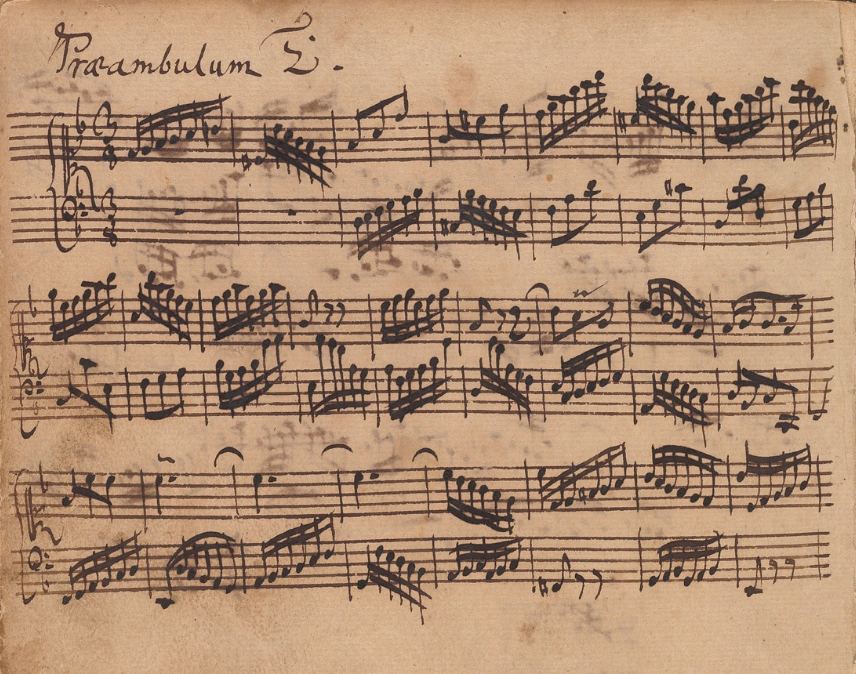
In this piece, words actually convey less than the sound itself does—and that’s precisely why its simplicity works so well with a faster heartbeat.
What I mean is that the amount of musical information per unit of time is quite low. It’s built around a simple, concrete idea: going up, going down, then gradually preparing for a leap by slowing down while the direction becomes sharper and more defined. Picture someone getting ready to jump across a lake: they pace back and forth a few times, then take a measured run-up—1, 2, 3, 4, 5, 6—and finally leap. The entire journey is essentially variations on the same basic motion, colored by different emotions and moods. Sometimes it even lingers on a single note to give the ear a rest and prevent the music from becoming overly complicated or tiring. These small contrasts and breathing spaces are what keep the piece consistently engaging, right up until it reaches its natural conclusion.
That quality is exactly what makes for excellent educational material. When a teacher—like Bach here—truly understands the essence, they don’t need to overcomplicate things. The core structure is presented cleanly and directly. Of course, one could argue that more complex techniques and pieces exist (and they do appear gradually through increasingly sophisticated inventions), but this particular piece stands out as one of the most intuitive and immediately graspable ones.
