Invention number 2 in C minor
This invention by Bach is unmistakably fluid and continuous in nature. On a larger scale, he presents a canonical version where one line — either identical or nearly identical — begins shortly after another. In essence, it's music resonating with itself.Beyond the sheer puzzle it creates, or rather the astonishing improbability of pulling off such a feat, the piece operates on a more fundamental level: it trains the hands to perform complex, independent actions while allowing two melodies to sing separately and clearly.Yet whatever Bach's original intention may have been, the music and the way he constructs it reveal far more than a mere technical exercise. To truly feel its essence, these three observations are sufficient:
The first line enters in the right hand, and the initial silence ensures the melody can emerge cleanly without immediate overlap — allowing the material, in a sense, to shine through itself.
The second line takes advantage of this setup and enters in a similar manner, at a moment when it can be clearly perceived and distinguished.
At certain points the strict pattern must break free, creating moments of excitement, a sense of coda-like resolution, or passages that frankly feel like an etude or a deliberate practice drill.
Nevertheless, once you've listened and absorbed the experience, analyzing the piece in detail — in search of deeper understanding — brings back the same phenomena: carefully managed releases of tension, and the lingering feeling that something remains unanswered, compelling us to keep searching for resolution.This is one key reason why, for me, Bach is never just a sonic puzzle. His music can serve as a profound model for any decision-making process or strategy that involves the human mind — its patterns of anticipation, delay, tension, release, and the pursuit of meaning. Now lets start with the details.
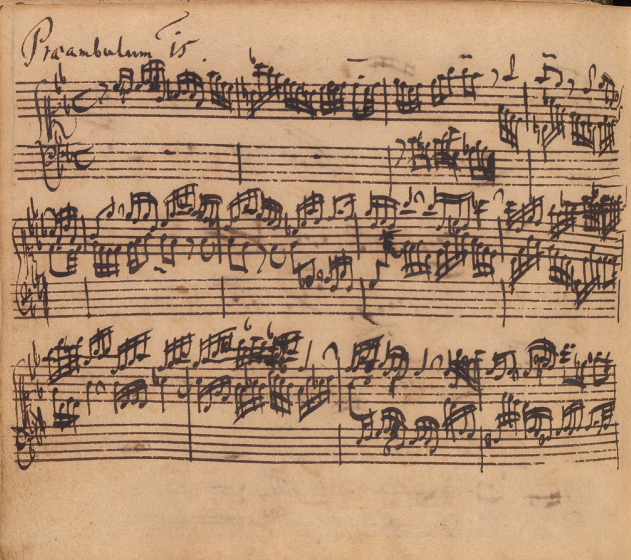
The First four note create a tension to be responded by the other consequencing four . this gives a sort of memntum to be expnaded by the jump that is making you ready for the second jump . After that the music seems ready enough to go full energy forward .
In my view, the composer is like someone giving the first ball in a Newton's cradle a gentle push — imparting just enough momentum to set the entire piece in motion. At the very beginning, the music may not sound perfectly ordered or predictable; that slight "imperfection" or looseness is precisely what allows everything to start flowing. This initial impulse creates a chain of questions, tensions, and unresolved elements — little sonic pendulums swinging — that the music will gradually answer, transfer, and resolve as it unfolds.
Image created by Grok.
Detailed, purely analytical dissection of every element isn’t truly productive — nor does it reveal Bach’s deeper intentions. He clearly composed these pieces primarily for educational purposes: as playable exercises designed to help performers grasp the essence of creativity. The real value lies not in exhaustive technical explanations, but in illuminating subtle hints that spark insight.This “guide” is written with adults in mind; if it were aimed at children, even the technical pointers would lose their benefit.So if, after the earlier explanation, you’re still wondering where else this concept of musical “energy” — akin to the elastic, stored potential in a stretched rubber band (or the momentum in the Newton’s cradle example) — appears: look to those longer-held notes that stand out against shorter surrounding elements. These extended tones often seem to pull inward first, gathering or concentrating the energy rather than immediately releasing it.The result is more profound than merely resolving tension: it delivers a complete, satisfying solution. The listener doesn’t just feel calm and tension-free; they also experience the subsequent pattern with heightened impact and clarity. The symmetry involved makes the whole process even more pleasing and natural.(The same inward pull and enhanced release will appear in the left hand a bit later — that’s simply built into the contrapuntal structure.)This is the second key hint about how this notion of musical energy truly operates within a piece.
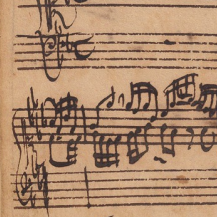
The pattern that keeps the music going.
You can call it dum dummm, or—just as Glenn Gould himself would probably sing it—poah POAH.
Of course, the piece includes conventional modulations and shifts to new tonalities that keep the music fresh and vibrant without ever losing its core essence. These can all be found detailed in countless analytical books, complete with chord labels and Roman numerals, so I won’t go through each one exhaustively here.The true impact of these harmonic excursions becomes fully apparent in the final section of the piece. After a serene, gentle wander into a calm, relaxed — almost joyful — space, the music abruptly shifts to a sense of worry or mounting tension. This change is achieved through sequences.I believe these sequential patterns make the emotional contrast much sharper and more palpable; that’s why they are essential whenever music needs to pivot its narrative direction. Imagine if such a shift were attempted with chaotic, unstructured patterns instead — the comparison of feelings would become extremely difficult to grasp. No one can prescribe exactly what feels “right” in every moment, but Bach’s simpler pieces make this fundamental principle strikingly clear.So, for instance, starting around 2:02 (or wherever the timing aligns in your recording), the music launches into a series of sequences: beginning from a state of calmness, passing through rounds of building tension, all to prepare us one final time to hear the main theme. This deliberate tension is absolutely necessary and clear — it creates the psychological space we need to fully absorb and appreciate the ending.To tie this back to our earlier metaphors, think of the sequences as a more extended “Newton’s cradle” chain: the calm excursion stores gentle momentum, the sequences transfer and amplify it into tension (like successive collisions building force), and the final return to the theme releases it with maximum clarity and satisfaction.
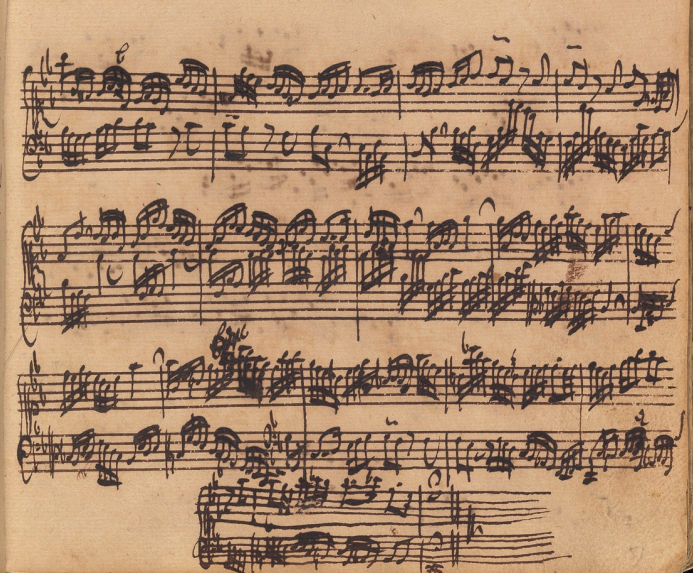
The second page shows ways to alter the same material and evoke entirely different feelings.
The ending, noted here, also reveals sequences in which the music subtly shifts mood. Clearly, each passage can be compared to the next. Because these are distinct sequences, those feelings become easier for us to perceive and contrast.
Chord progressions and detailed harmonic analysis reveal little to me personally. What truly stands out are the many symmetries and patterns woven into each individual line — elements that could perhaps be explored further in the future. Yet the explanations and hints shared so far already uncover most of the essential structure in Bach inventions in this particular Invention. They don’t represent every technique he uses to invent with sound, but they equip the listener with a clear sense of what to listen for and seek out.Ultimately, true understanding rests solely with the individual: it’s a personal responsibility and something only one’s own attentive listening and inner perception can achieve.
